Conference Profile
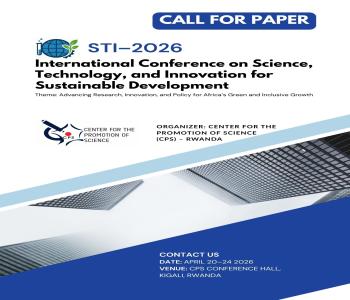
About Conference
Introduction & Rationale
Africa’s sustainable development and economic transformation depend on harnessing the power of science, technology and innovation (STI). Experts at the United Nations Economic Commission for Africa (UNECA) note that achieving the targets of the 2030 Sustainable Development Agenda and the African Union’s Agenda 2063 requires leveraging STI to fight multidimensional vulnerabilities so Africa can move from crisis to sustainable development. The African Union’s Science, Technology and Innovation Division similarly recognises that STI is a universal enabler for addressing poverty, inequalities, diseases, climate change impacts and environmental conservation, and therefore plays a central role in socio‑economic development Sustainable growth must also be green and inclusive. Inclusive green growth is defined as a development mode that coordinates economic growth, ecological protection and social equity, pursuing fairness, efficiency and the internal consistency between development and environment. It requires innovation and policy reforms to ensure that environmental stewardship and social inclusion underpin economic progress. The STI–2026 conference will provide a platform for researchers, innovators, policymakers and practitioners to discuss how cutting‑edge science, technological innovation and evidence‑informed policy can drive Africa’s green and inclusive growth. By bringing together diverse disciplines and stakeholders, the conference aims to generate knowledge and partnerships necessary to accelerate progress toward the Sustainable Development Goals (SDGs) and realise the aspirations of Agenda 2063.
The conference theme
“Advancing Research, Innovation, and Policy for Africa’s Green and Inclusive Growth” – invites participants to explore how scientific research, technological advances and policy innovations can work together to promote environmentally sustainable and socially inclusive development across Africa. Conference objectives Showcase cutting‑edge research on science and technology solutions that address Africa’s sustainable development challenges. Highlight innovations – including digital technologies, renewable energy, agricultural biotechnology and health technologies – that can support green economies and inclusive growth. Discuss policy frameworks and governance approaches that catalyse research and innovation, while ensuring equitable distribution of benefits and reducing gender and regional disparities. Create a platform for dialogue and networking among researchers, industry practitioners, development partners, community organisations and policymakers. Strengthen collaboration within Africa and with global partners to accelerate progress toward the SDGs and Agenda 2063.
Topics of Interest
The conference welcomes original research papers, case studies, policy analyses, technical reports and practitioner insights on (but not limited to) the following topics:
- Science and technology solutions for achieving the Sustainable Development Goals.
- Digital transformation, artificial intelligence, data science and blockchain applications for sustainable development.
- Renewable energy, climate resilience and clean technology innovations. Green economy, circular innovation, waste reduction and sustainable manufacturing.
- STI–2026 Inclusive innovation and entrepreneurship, including support for women and youth innovators. Sustainable agriculture, food security and smart farming technologies.
- Health technologies, pandemic preparedness and strengthening health systems.
- Policy frameworks for science, technology and innovation; governance of emerging technologies; regulation of AI and data.
- Human capital development, STEM education, research infrastructures and talent mobility.
- Regional cooperation, South–South partnerships and financing models for STI
Submission Guidelines & Categories
Paper categories
- Research Papers: Full manuscripts (6–8 pages) presenting original research findings, theoretical developments, data analyses or modelling approaches.
- Case Studies & Best Practices: Detailed case studies, evaluation reports or practice‑oriented analyses highlighting lessons learned from sustainable development initiatives.
- Policy Papers: Analytical papers that examine policy instruments, regulatory frameworks or governance strategies relevant to STI and sustainable development.
- Posters & Demonstrations: Visual or interactive presentations of prototypes, research in progress, pilot projects or educational tools.
Abstracts
Abstracts should be 250–300 words and include a title, list of authors, affiliations, email address, up to five keywords, a brief statement of the problem, methodology and key results or insights.
- Full papers Full papers should be 6–8 pages, formatted in Microsoft Word (.docx) or PDF, with 1‑inch margins, single‑line spacing and 12‑point Times New Roman or an equivalent font. Include an abstract, introduction, methods, results, discussion, conclusion and references. Use APA or IEEE citation style consistently.
- Submission platform All abstracts and papers must be submitted via the online conference portal. Each submission will be blind‑reviewed by at least two experts. Accepted papers will be scheduled for oral presentations or posters and published in the conference proceedings.
- Language Papers may be submitted in English or French. Authors are responsible for language quality.
Important Dates
Milestone & Date
- Call for Papers Announced - 10 August 2025
- Abstract Submission Deadline - 31 December 2025
- Full Paper Submission Deadline - 15 February 2026
- Notification of Acceptance - 1 March 2026
- Early Registration Deadline - 20 March 2026
- Conference Dates - 20–24 April 2026 STI–2026
Registration & Fees
All presenters and participants must register for the conference. The registration fee contributes to conference materials, refreshments, lunches and access to all sessions. Travel and accommodation are not included.
- Category - Regular Participants
- Advance Registration - $500 USD
- On‑site Registration - $1,000 USD
Payment methods: Advance registrations must be made via bank transfer or credit card through the online portal; detailed instructions will be sent upon acceptance. Cash payment is available at the venue for on‑site registration only.
Venue & Logistics
Venue
The conference will be held at the CPS Conference Hall, located in central Kigali, Rwanda. Kigali offers a safe and vibrant environment, and April falls within the dry season with pleasant temperatures.
Travel & visas
International participants should check visa requirements for Rwanda. Many visitors can obtain an e‑visa online prior to arrival; citizens of African Union member states may be eligible for visa‑on‑arrival. All travelers must possess a passport valid for at least six months beyond the date of entry.
Accommodation
A list of recommended hotels and guest houses near the conference venue will be provided on the conference website. Participants are encouraged to book early.
Health & COVID‑19 protocols
Attendees should monitor updates on health protocols and vaccination requirements. The organisers will adhere to Rwanda’s public health guidelines and communicate any necessary measures to participants.
For international participants, we have arranged convenient airport pickup and drop-off services, local transportation, affordable meals, and comfortable accommodation for a fee. For details, please contact us at: cpslogistics@cps.rw
About the Organizer
Center for the Promotion of Science (CPS) – Rwanda. CPS is a leading research and advocacy centre dedicated to promoting science and technology for sustainable development across Rwanda and the wider region. It facilitates research, innovation, policy dialogue and capacity building to foster inclusive growth and a knowledge‑based economy.
OUR VISION
To become a leading center of excellence in the promotion of science, technology, and innovation for sustainable development in Rwanda and Africa.
OUR MISSION
To promote the understanding, application, and advancement of science and technology through inclusive education, policy engagement, research, and innovation, thereby contributing to national development and regional transformation.
Contact Us
Conference Secretariat
Center for the Promotion of Science (CPS) – Rwanda
CPS Conference Center, Kigali, Rwanda
Email: info@cps.rw
Telephone: +250 792 411 913
Website: www.cps.rw