Conference Profile
About Conference
Introduction & Rationale
The Fourth Industrial Revolution (4IR) is transforming societies and economies at an unprecedented pace. Digital Science, Artificial Intelligence (AI), Big Data, and Robotics are no longer just futuristic concepts—they are real, disruptive forces driving innovation, efficiency, and new business models across the globe.
For Africa, these technologies present a unique opportunity to bypass traditional development barriers, enhance productivity, create new industries, and solve long-standing socio-economic challenges in health, education, agriculture, governance, manufacturing, and beyond. From precision farming that tackles food insecurity to AI-powered diagnostics that address healthcare shortages, the potential for transformation is vast.
Yet, unlocking this potential requires more than technology adoption. It calls for strategic investment in research and development, inclusive policy frameworks, skilled human capital, and responsible innovation that addresses ethical, social, and environmental implications. Without these, the benefits of emerging technologies may remain concentrated in a few hands, deepening inequalities rather than reducing them.
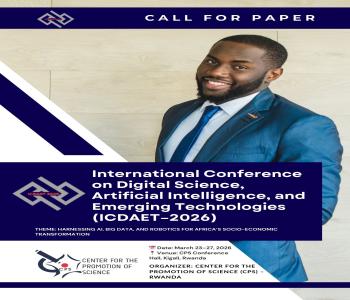
The International Conference on Digital Science, Artificial Intelligence, and Emerging Technologies (ICDAET–2026) is designed as a multi-stakeholder platform to explore how cutting-edge technologies can be adapted to Africa’s realities and scaled to achieve the Sustainable Development Goals (SDGs) and the African Union’s Agenda 2063. It will bring together researchers, innovators, entrepreneurs, policymakers, and development partners to share knowledge, demonstrate innovations, debate challenges, and forge partnerships that translate ideas into action.
By hosting ICDAET–2026 in Kigali—one of Africa’s fastest-growing technology hubs—the conference aims to inspire practical collaboration that accelerates Africa’s digital transformation journey while safeguarding ethics, equity, and sustainability.
Topics of Interest
Artificial Intelligence & Machine Learning
- AI solutions for governance, public administration, and service delivery.
- Predictive analytics for economic forecasting and resource management.
- AI applications in healthcare (diagnostics, drug discovery, telemedicine).
- Natural language processing for African languages.
- AI in creative industries, media, and culture.
Big Data & Data Governance
- Data collection, storage, and analytics for sustainable development.
- Building data ecosystems and open-data platforms.
- Ethical data governance and privacy protection.
- Data science applications in education, agriculture, and climate change.
- Real-time analytics for disaster management and crisis response.
Robotics, Automation & Industry 4.0
- Robotics in manufacturing, logistics, and supply chains.
- Agricultural robotics for precision farming and post-harvest handling.
- Automation in mining, construction, and infrastructure projects.
- Human–robot collaboration and safety considerations.
Digital Infrastructure & Smart Systems
- Internet of Things (IoT) for smart cities and rural development.
- 5G networks and connectivity expansion strategies.
- Cloud computing and edge computing applications.
- Blockchain for secure transactions, supply chain tracking, and governance.
Ethics, Policy & Regulation
- AI and robotics regulation in African contexts.
- Addressing algorithmic bias and promoting inclusive AI.
- Cybersecurity policies for emerging technologies.
- Intellectual property and technology transfer policies.
Human Capital, Skills & Entrepreneurship
- Digital literacy and STEM education for the future workforce.
- Women and youth participation in AI, robotics, and data science.
- Incubation, acceleration, and funding models for tech startups.
- Public–private partnerships for technology adoption.
Cross-sectoral Innovations
- Integrating AI, Big Data, and Robotics for climate resilience.
- Technology-driven approaches to food security and nutrition.
- Digital financial inclusion through fintech and AI-powered credit scoring.
- Social innovation using emerging technologies for community empowerment.
Submission Guidelines & Categories
Research Papers: 6–8 pages presenting original research, data analysis, or theoretical work.
Case Studies & Best Practices: Applied examples, pilots, or evaluations.
Policy Papers: Analysis of technology governance, ethics, and policy.
Posters & Demonstrations: Visual or interactive presentations.
Abstracts: 250–300 words, including title, authors, affiliations, keywords, methodology, and key findings.
Full Papers: 6–8 pages, Word or PDF, 12-point Times New Roman, 1-inch margins, APA or IEEE citations.
Submission: All submissions must be made via the online conference portal and will be peer-reviewed by at least two experts.
Language: English or French.
Important Dates
Call for Papers Announced: 10 August 2025
Abstract Submission Deadline: 31 December 2025
Full Paper Submission Deadline: 15 February 2026
Notification of Acceptance: 1 March 2026
Early Registration Deadline: 20 March 2026
Conference Dates: 23–27 March 2026
Venue & Logistics
International Participants: We have arranged convenient airport pickup and drop-off, local transportation, affordable meals, and comfortable accommodation for a fee. For details, contact: cpslogistics@cps.rw.
Venue: CPS Conference Hall, Kigali, Rwanda – centrally located, with modern facilities in a safe and vibrant city. March offers pleasant weather in Rwanda’s dry season.
Travel & Visas: Many participants can obtain an e-visa online; AU citizens may get visa-on-arrival. Passports must be valid for at least six months after entry.
About the Organizer
Center for the Promotion of Science (CPS) – Rwanda is a leading research and advocacy center advancing science, technology, and innovation for sustainable development. CPS works with governments, universities, industry, and civil society to promote inclusive, knowledge-based growth.
Center for the Promotion of Science (CPS) – Rwanda. CPS is a leading research and advocacy centre dedicated to promoting science and technology for sustainable development across Rwanda and the wider region. It facilitates research, innovation, policy dialogue and capacity building to foster inclusive growth and a knowledge‑based economy.
OUR VISION
To become a leading center of excellence in the promotion of science, technology, and innovation for sustainable development in Rwanda and Africa.
OUR MISSION
To promote the understanding, application, and advancement of science and technology through inclusive education, policy engagement, research, and innovation, thereby contributing to national development and regional transformation.
Contact Us
Conference Secretariat
Center for the Promotion of Science (CPS) – Rwanda
CPS Conference Center, Kigali, Rwanda
Email: info@cps.rw
Telephone: +250 792 411 913
Website: www.cps.rw